Discover why urban children are developing early myopia, the hidden science behind screen time, and how daily sunlight can protect your child’s vision.
The Story: Meet Vihaan
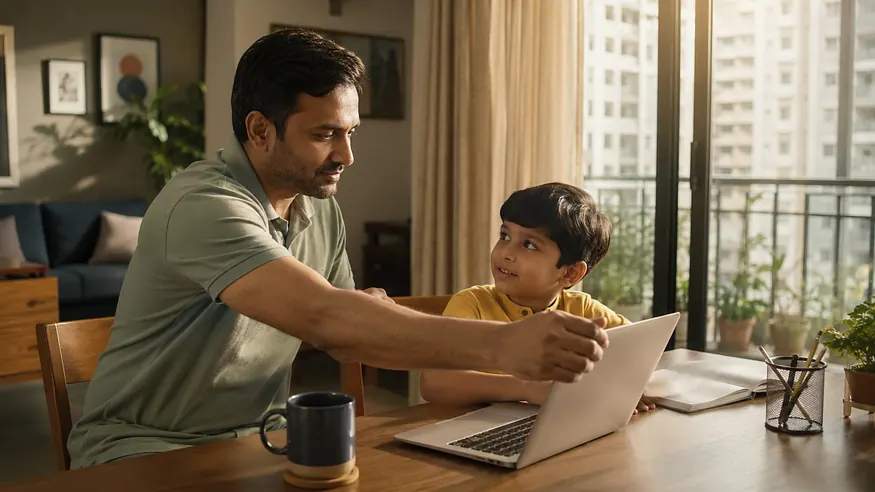
He is a bright seven-year-old living in HSR Layout, Bengaluru. His parents work in tech and thought they were doing everything perfectly by restricting his tablet use to just weekends. But during a recent drawing session at the kitchen table, his father noticed Vihaan kept rubbing his eyes and leaning within inches of his paper. They assumed he was just tired. It was actually the early onset of childhood myopia.
Many parents in urban India share this exact story. We live in a digital world, and we naturally blame screens for everything. Let us talk over a cup of chai about what is really happening to your child’s eyes.
Think of your child’s eye like a camera lens made of soft clay. When they stare at a screen or a book inches from their face for hours, the eye muscles lock into a near-focus mode. Over time, the eyeball actually elongates to make this near-focusing easier. Once the shape changes, distant objects become permanently blurry.
This is where sunlight comes in. Natural sunlight acts like a chemical signal to stop the eye from growing too long. Exposure to bright daylight releases dopamine in the retina. This keeps the eyeball in its proper shape. According to the IAP and the WHO, staying indoors is a massive risk factor for early vision loss. Keeping kids off screens is only half the solution. They also need to go outside.
Your Stakeholder Blueprint
What Parents Should Do
- Limit recreational screen time according to IAP guidelines.
- Ensure your child spends at least two hours outdoors in natural daylight every day.
- Enforce the 20–20–20 rule during all study and reading sessions.
What Educators Should Do
- Seat children with suspected vision issues closer to the front of the classroom.
- Incorporate regular visual breaks during long reading sessions.
- Alert parents immediately if a child frequently squints or copies notes incorrectly from the board.
When To See A Paediatrician (Red Flags)
- Your child frequently rubs their eyes or blinks excessively.
- They hold books or screens right up to their nose.
- They complain of headaches or tired eyes after a day at school.
- They sit unusually close to the television.
Your Daily Vision Checklist
- Track daily outdoor time to ensure they hit the two-hour mark.
- Keep all screens at least an arm’s length away from their face.
- Set a timer for the 20–20–20 rule during homework time.
- Switch to larger screens like a TV or desktop instead of handheld phones.
- Ensure the study room is well-lit with plenty of natural light.
- Schedule a comprehensive annual eye check-up starting at age three.
- Watch for subtle behavioural signs like head tilting or avoiding distant objects.
FAQ:
Why is sunlight so important for my child’s eyes?
Sunlight plays a critical role in early eye development. Exposure to bright, natural light triggers the release of dopamine inside the retina. This chemical physically stops the eyeball from growing too long. This elongation is the primary structural cause of childhood myopia. The IAP suggests that children spend at least two hours outdoors every day to provide the natural light exposure needed to protect their long-term vision.
Are blue light blocking glasses effective for kids?
Many parents buy these glasses hoping to protect their children from screen damage. While blue light filters can reduce screen glare and help protect sleep cycles when used in the evening, they do not prevent myopia. They also do not stop the eye muscle strain caused by staring at a fixed distance. Taking regular visual breaks and getting enough daily outdoor time remain the most effective strategies for your child.
How do I know if my child needs an eye test?
Children rarely complain about blurry vision because they assume everyone sees the world exactly as they do. You must watch their behaviour instead. Notice if your child squints at the television, rubs their eyes frequently, or tilts their head to read. Frequent headaches after school or holding devices very close to their face are also strong warning signs. If you spot any of these habits, you should book a vision assessment immediately.
Early detection changes everything. Book a SKIDS developmental screening at: https://www.skids.clinic/