Visual Sequential Memory in Kids: Spelling & Focus
Does your child study a spelling list until they are in tears, only to write the letters in the wrong order the very next day? Do they struggle to remember the steps of a math equation they just watched the teacher solve?
In the high-demand classroom of 2026, this is rarely a lack of effort. Often, the hidden hurdle is a lag in Visual Sequential Memory, the brain’s ability to recall the exact order of a series of visual images.
Understanding Visual Sequential Memory
While [Figure-Ground Perception] is the brain’s ability to find a specific object in a crowded room, Visual Sequential Memory is the brain’s “video recorder.” It allows a child to see a sequence of shapes, letters, or numbers and hold that exact order in their mind.
When a neurotypical child looks at the word “B-R-E-A-D,” their brain takes a rapid mental photograph. When they look down at their paper, they simply “play back” the sequence. However, for a child with a lag in this area, the brain remembers the letters but loses the file structure. They might write “B-E-R-A-D” or “D-R-E-A-B.”
The Spelling Test Disconnect
This invisible lag creates profound frustration. A child might practice spelling words verbally and score 100% at the kitchen table because they are using auditory memory. But when they get to school and must rely on visual-motor systems to write, the sequence scrambles. This discrepancy often leads to the unfair assumption that the child is “careless,” which rapidly drains their [Social Battery] and self-esteem.
The Math and Reading Comprehension Tax
The impact extends far beyond the spelling bee:
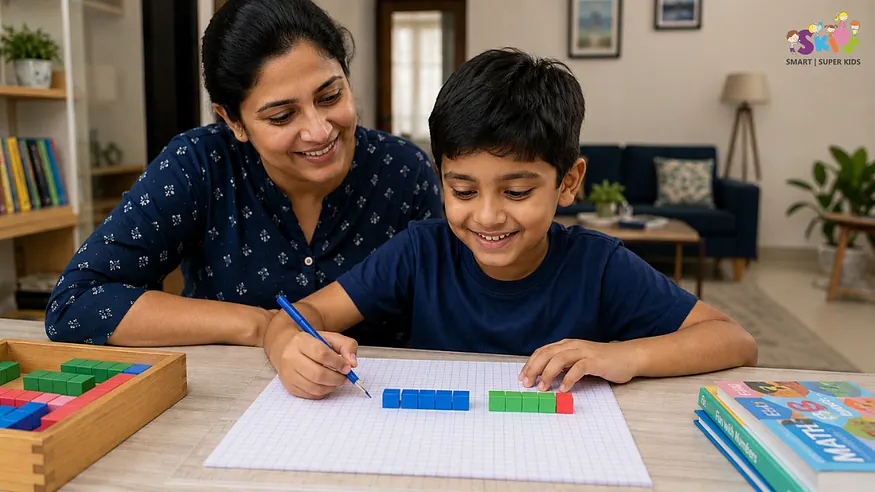
• Mathematics: Math relies on sequential formulas (e.g., long division). If the visual memory of the sequence fades, the child gets stuck on step two.
• Reading: If a child cannot remember the sequence of words at the beginning of a paragraph, their working memory overflows. They reach the end of the page with no comprehension of the story.
The Barker Hypothesis: Programming Sequential Endurance
According to the Barker Hypothesis, early childhood cognitive conditioning acts as the permanent biological blueprint for adult capability. If a child spends their peak developmental years (ages 5–12) struggling with an uncalibrated sequencing map, it programs the adult brain for higher cognitive fatigue during complex tasks like coding or data analysis.
Strengthening this “mental camera” today acts as a neurological vaccine for lifelong organisational intelligence.
The Stakeholder Blueprint: Home, School, and Clinic
To support these children, we must transition from demanding “more studying” to explicitly training the brain’s sequencing pathways.
For Parents: The “Pattern Play” Home
• The “What’s Missing?” Game: Line up 3 to 5 objects. Let your child look for 10 seconds. Have them close their eyes, then remove one object or swap the order. Ask them to identify the change.
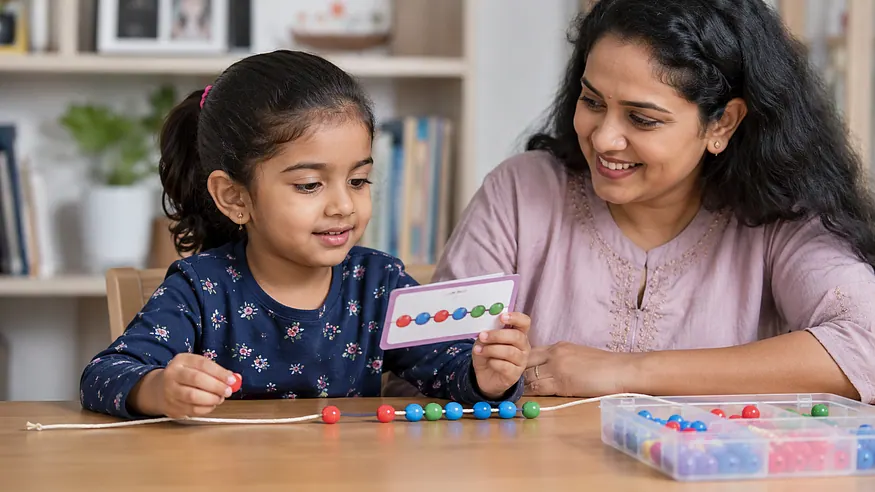
• Beading and Pattern Blocks: Use Legos or beads to create a specific pattern (red, blue, green, red). Ask the child to replicate it from memory. The tactile input provides [Proprioceptive] feedback, anchoring the visual memory.
For Educators: The Classroom Visual Audit
• The Power of “Chunking”: Break 10-letter words into 3–3–4 patterns, similar to a phone number. Memorising two small chunks is neurologically easier than one long sequence.
• Vertical Math Alignment: Provide worksheets with vertical lines or colour-coded columns. This acts as an external visual scaffold, reducing the internal memory load required to keep numbers aligned.
For Paediatricians: Screening the “Poor Speller”
• The Sequential Audit: We advocate for checking visual processing markers during routine evaluations. If a child has high verbal intelligence but consistently fails written spelling or struggles to copy shapes, clinicians should refer them to a Developmental Optometrist or Occupational Therapist (OT) before diagnosing a general learning disability.
What to Observe: A Parent’s Checklist
• Verbal vs. Written Gap: Can they spell it out loud but not on paper?
• Sequence Struggles: Do they have trouble remembering their own phone number or locker combination?
• Multi-Step Forgetfulness: Do they forget the middle steps of a task (like tying a shoe) immediately after a demo?
• Reading Regression: Do they read “saw” as “was” or “top” as “pot”?
Frequently Asked Questions
- Is Visual Sequential Memory the same as Dyslexia?
No. Dyslexia is a language-based difficulty with decoding sounds (phonemes). Visual Sequential Memory is a visual-cognitive issue. While the results on a spelling test look similar, they originate in different processing centres.
2. Can screen time affect this skill?
Yes. Modern digital content “fast-forwards” the sequencing for the child. Because videos move so quickly, the brain never has to pause and “hold” a sequence. Analogue, step-by-step building games are essential for training this muscle.
3. Does this connect to Visual Spatial Relations?
Absolutely. As discussed on May 11, Visual Spatial Relations help a child identify the direction of a single letter (b vs. d). Visual Sequential Memory helps them remember the order of those letters. A child needs both to read and write efficiently.
The SKIDS Shield
Traditional check-ups focus on what a child can read aloud, but they often miss how the brain stores the image. SKIDS Advanced Discovery looks at the “Mental Camera.” By auditing visual processing markers alongside academic and behavioural feedback, we help you, your school, and your paediatrician identify the “Sequence Lag” before it drains your child’s confidence.
Is an uncalibrated memory affecting your child’s spelling and focus?
[Explore SKIDS Advanced Discovery: The Path to a Smart Super Kid]