Does your child still reverse “b” and “d” well past first grade, or do they constantly bump into doorframes as if they can’t gauge the distance? In the modern classroom, these struggles are frequently mislabeled as dyslexia or simple clumsiness. Often, the hidden culprit is a lag in Visual Spatial Relations, the brain’s internal map of where objects are in the physical world.
The “Internal Map”: Why Direction Dictates Decoding
Understanding Visual Spatial Relations
Visual spatial relations refer to the brain’s ability to process the position of objects in space, both in relation to oneself and in relation to other objects. It is the neurological foundation for understanding concepts like “left and right,” “up and down,” and “front and back.”
For a toddler, learning that a chair is still a chair whether it is facing forward, backward, or upside down is a major cognitive milestone. The brain learns that the orientation of an object does not change its identity. However, when a child enters school and begins learning to read, this exact rule is suddenly reversed.
The Letter Reversal Loop (“b” vs. “d”)
In the English alphabet, spatial orientation changes everything. A circle with a line attached to it is a “b” if the line is on the left, a “d” if the line is on the right, a “p” if the line drops down on the left, and a “q” if it drops down on the right.
For a child with a lag in visual spatial relations, the brain struggles to process these minute directional differences. They aren’t seeing the letter backward; their brain simply hasn’t developed the spatial “anchor” required to lock the letter’s identity to its specific direction. This makes decoding words exhausting and drains their Working Memory (see our Mar 31 post) before they can even comprehend the sentence.
Math Alignment and Personal Space
The impact of this lag extends heavily into mathematics and social interactions. A child with poor spatial relations will often struggle to line up columns of numbers for addition or subtraction, writing the “tens” under the “ones,” leading to constant calculation errors.
Socially, they may struggle with spatial boundaries, standing too close to peers or bumping into desks. Navigating this unpredictable physical environment results in a rapid drain of their Social Battery.
The Barker Hypothesis: Programming Spatial Intelligence
According to the Barker Hypothesis, early childhood developmental conditioning acts as the permanent biological blueprint for adult health and capability. If a child spends their peak developmental years (ages 5–12) struggling with an uncalibrated internal map, it programs the adult brain for lower spatial intelligence, persistent left-right confusion, and higher anxiety in visually demanding environments (such as driving in heavy traffic).
Strengthening this spatial map today acts as a “neurological vaccine” for lifelong environmental confidence and mathematical proficiency.
The Stakeholder Blueprint: Home, School, and Clinic
To support a child with spatial relation lags, we must transition from demanding they “look closer” to giving them physical, multi-sensory anchors across their ecosystem.
For Parents: The “3D Anchor” Home
• The “Body-First” Approach: Spatial relations start with the body before they move to paper. Play games like Twister or set up obstacle courses that require the child to physically move “under,” “over,” “left of,” and “right of” objects. Once they feel the space with their body, their eyes can translate it to the page.
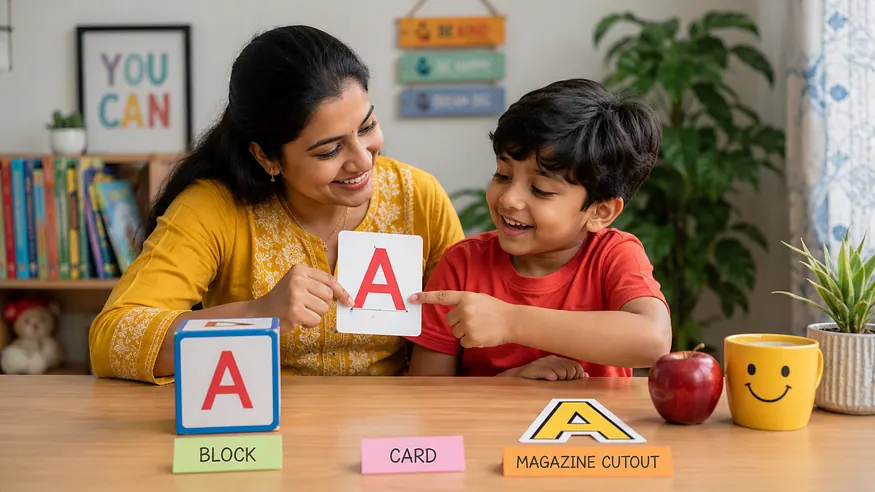
• Tactile Letter Building: Do not use flat flashcards to correct “b” and “d” reversals. Use clay, pipe cleaners, or wooden blocks to build the letters. The brain relies on Proprioception (the sense of touch and joint position) to anchor spatial concepts much faster than visual input alone.
For Educators: The Classroom Environmental Audit
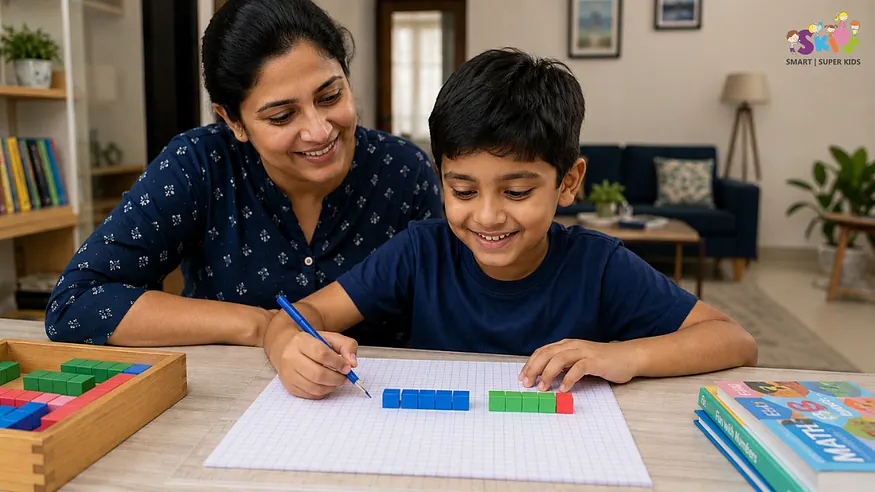
• Graph Paper Accommodations: For students who struggle to align math problems, standard lined paper is insufficient. Educators should provide large-grid graph paper, requiring the student to place exactly one number inside each box. This provides an immediate, visual-spatial boundary that prevents calculation drift.
• The “Anchor Hand” Strategy: To help with left-to-right reading and writing, have the student place a highly visible sticker or a bright wristband on their left hand (or the top left corner of their desk). This serves as a constant, passive “starting point” anchor for their eyes, reducing the cognitive load required to figure out where to begin.
For Paediatricians: Screening the “Dyslexic” Profile
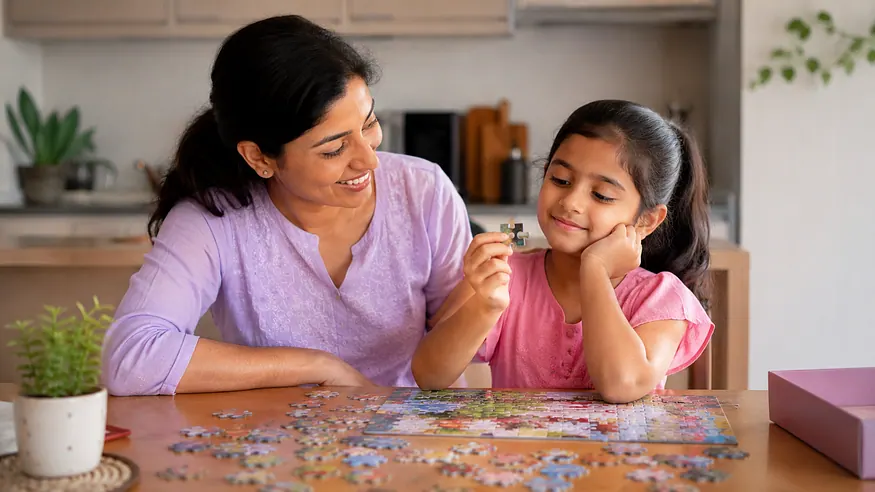
• The Form-Board Audit: We advocate for checking spatial processing markers during routine learning evaluations. Simple form-board puzzles or asking a child to replicate a specific pattern of blocks can reveal if the issue is a visual-spatial lag rather than a phonological (language-based) deficit. Clinicians should refer these families to a Paediatric Occupational Therapist (OT) or a Developmental Optometrist for visual-spatial therapy before diagnosing dyslexia.
What to Observe This Week: A Parent’s Checklist
• Persistent Reversals: Does your child consistently reverse letters (b/d, p/q) or entire words (was/saw) well past the age of 7?
• Left/Right Confusion: Do they still struggle to identify their left from their right without using a trick (like making an ‘L’ with their fingers)?
• Poor Spacing: When writing sentences, do they crush words together or leave massive, irregular gaps between them?
• Spatial Clumsiness: Do they frequently knock over cups at the dinner table or misjudge the distance when reaching for an object?
When to Seek Paediatric Review
Consult your paediatrician or an Occupational Therapist (OT) if:
1. Letter and number reversals persist aggressively beyond the second grade and are severely stalling reading progress.
2. The child experiences intense frustration or tearfulness during math assignments solely due to an inability to organise the numbers on the page.
3. Spatial misjudgments become a safety issue (e.g., frequently missing steps on a staircase or misjudging curbs).
4. Standard phonics tutoring has yielded no improvement in reading fluency over a 3- to 6-month period.
Frequently Asked Questions
- What is the difference between Visual Spatial Relations and Dyslexia?
Dyslexia is primarily a neurological challenge with processing the sounds of language (phonological processing). Visual-spatial relation lags are mechanical issues with processing direction and space. Both can cause letter reversals, but they require entirely different therapeutic approaches.
2. Can screen time make spatial relations worse?
Yes. Tablets and televisions operate on a flat, 2D plane. The brain needs to manipulate real, 3D objects in the physical world to build a robust spatial map. High screen time deprives the developing brain of this necessary 3D data.
3. Is this related to Crossing the Midline?
Absolutely. As we discussed in our May 8 post, if a child cannot smoothly cross the centre of their body, they will naturally struggle to understand the concepts of “left” and “right” because their brain has not integrated the two halves of their physical space.
The SKIDS Shield
Traditional check-ups focus on what a child can read aloud, but they often miss how the brain organises the page. SKIDS Advanced Discovery looks at the “Internal Map.” By auditing visual-spatial markers alongside academic and behavioural feedback, we help you, your school, and your paediatrician identify the “Directional Lag” before it is misdiagnosed as Dyslexia.
Is an uncalibrated internal map causing your child’s academic fatigue?
[Explore SKIDS Advanced Discovery: The Path to a Smart Super Kid]