
Pediatric Executive Function: Focus & Organisation Guide
Does your child vividly recall every intricate detail of a two-hour movie, yet struggle to execute the three simple steps required to get ready for school?
Before assuming they simply aren’t listening, consider their cognitive dashboard. In the high-demand environment of 2026, building pediatric executive function is the key to helping children translate their brilliant ideas into focused, everyday action.
The Brain’s CEO: Turning Integration into Action
Earlier this week, we explored the “Generalisation Engine”, the brain’s ability to weave sight, sound, and touch into multisensory integration. But once the brain interprets this sensory data, it must decide how to act.
This is the domain of Executive Function. Located primarily in the prefrontal cortex, executive function acts as the brain’s Chief Executive Officer, managing time, attention, and behaviour.
The Three Pillars of Cognitive Control
Executive function relies on three interconnected mental skills:
- Working Memory: The ability to hold and manipulate information over short periods (e.g., remembering a sequence of instructions).
- Mental Flexibility: The capacity to sustain or shift attention in response to changing demands or social rules.
- Self-Control (Inhibition): The ability to set priorities and resist impulsive responses.
When these skills develop at a slower pace than their peers, children often struggle with “simple” daily routines, leading to chronic frustration and the depletion of their cognitive and emotional energy.
The Barker Hypothesis: Programming the Task-Map
According to the Barker Hypothesis, early childhood cognitive conditioning creates a biological blueprint for adult capability. If a child spends their peak developmental years (ages 5–12) struggling with an uncalibrated cognitive “dashboard,” it may set a trajectory for increased cognitive fatigue and professional burnout in adulthood.
Scaffolding these executive pathways today acts as a “neurological vaccine” for lifelong organisational intelligence and mental resilience.
The Stakeholder Blueprint: Home, School, and Clinic
We must move beyond telling children to “try harder.” Instead, we must shift toward explicit training and structural support.
For Parents: The “External Dashboard” Home
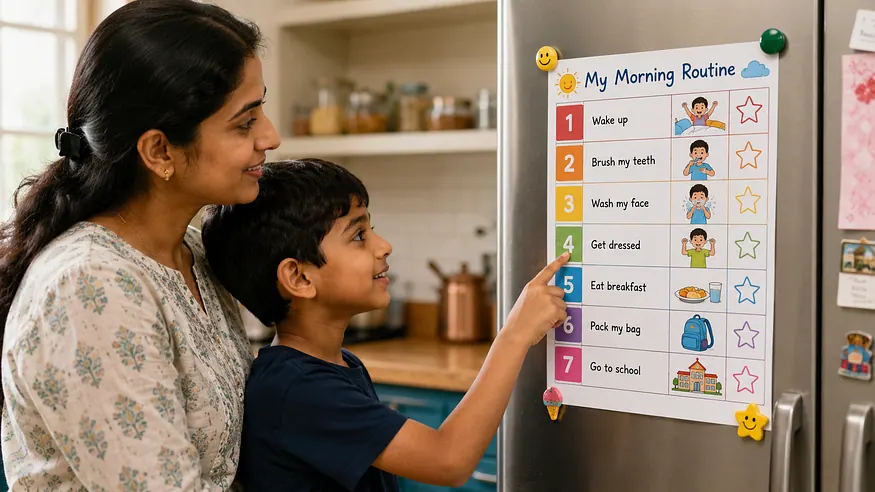
- Visual Scaffolding: Instead of a string of verbal commands, use visual checklists. When a child’s working memory buffer is full, a physical picture-list on the fridge acts as an “external brain,” preserving their mental energy.
- The “Backward Chaining” Method: Assist them with the first few steps of a multi-step task, and let them complete the final one. Gradually increase their responsibility for the earlier steps. This builds confidence and creates structural “muscle memory.”
For Educators: The Classroom Cognitive Audit
- The “First-Then” Strategy: Limit instructions to two steps at a time. Using “First [A], Then [B]” allows the child to lock in the plan before their working memory load is overwhelmed.
- Pre-Organised Stations: For complex tasks, provide tools in the exact order of use. This allows students to focus on the educational content rather than the logistics of tool management.
What to Observe: A Parent’s Checklist
- Mid-Task Stalling: Do they frequently stop in the middle of a room, forgetting their original intention?
- Transition Friction: Is there significant distress when switching from a preferred activity to a required one?
- Impulse Control: Do they consistently interrupt or blurt out answers, despite knowing the rules?
- Multi-Step Memory: Do they require repeated prompts to complete a simple three-part verbal command?
When to Seek Pediatric Review
Consult a professional if:
- Routine tasks consistently result in emotional meltdowns or school refusal.
- Disorganisation leads to significant academic decline despite high conceptual ability.
- Impulsive behaviours pose a safety risk to themselves or others.
- You notice a sharp, unexplained regression in previously mastered organisational skills.
FAQs
- Is a lack of executive function the same as ADHD?
Not necessarily. While many children with ADHD face executive function challenges, these challenges can also stem from sensory overload, sleep deprivation, or uneven developmental pacing.
2. Can screen time affect working memory?
Yes. High-intensity digital input often fragments attention, training the brain to expect instant gratification. Over time, this can weaken the “mental flexibility” and “inhibition” pillars of executive function.
3. Will they outgrow poor organisation?
Executive function naturally develops into the mid-20s. However, children do not simply “outgrow” deficits; they require explicit scaffolding and practice to strengthen these neural pathways effectively.
The SKIDS Shield
Traditional check-ups often track what a child learns, but they frequently overlook how their brain organises that learning.
SKIDS Advanced Discovery maps the complete “Cognitive Dashboard.” By auditing working memory and processing markers alongside behavioural feedback, we help you, your school, and your paediatrician identify the “Executive Gap” before it drains your child’s love of learning.
Is an uncalibrated organisational engine holding back your child’s brilliance?
[Explore SKIDS Advanced Discovery: The Path to a Smart Super Kid]