
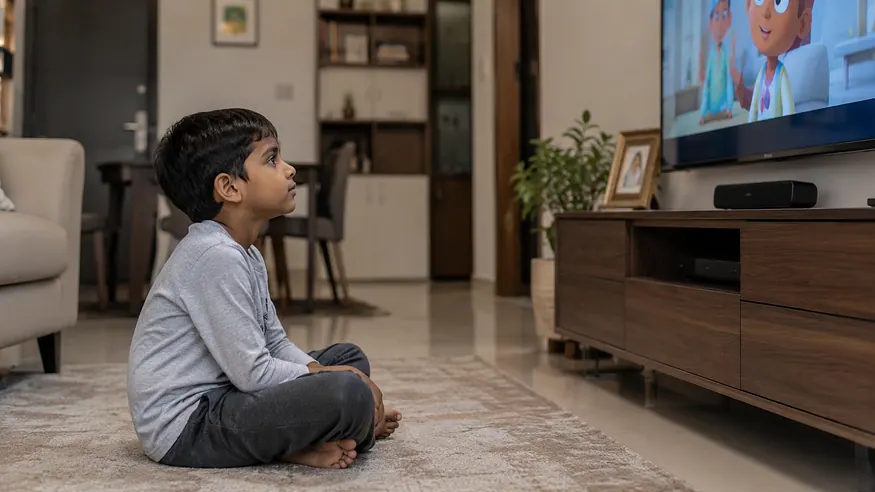
You are probably feeling it right now: that familiar, nagging pit in your stomach every time you hand your child a tablet so you can take an uninterrupted work call or finally prepare dinner. In today’s hyper-connected world, screen time has become the modern parent’s ultimate source of anxiety. But what if the guilt you carry is actually the real villain in this scenario?
Children aged 2 to 5 years spend an average of 2 hours and 25 minutes per day on screens. While these numbers are often cited to warn parents about the dangers of digital consumption, a crucial element is frequently missing from the conversation. Often, it is not the screen time itself that causes the most immediate friction in the home — it is the profound guilt, stress, and anxiety that parents project, and that children inevitably absorb.
Meet Rohan, a 6-year-old
Meet Rohan, a vibrant and curious 6-year-old growing up in Bengaluru. Like many children in a bustling, fast-paced tech hub, Rohan is naturally inquisitive and incredibly bright. He excels in his early schoolwork and shows a remarkable aptitude for solving complex visual puzzles. His parents, busy professionals trying to balance demanding careers with active family life, are hyper-aware of the prevailing clinical narratives around screen time. They strictly limit his device usage to exactly one hour a day.
However, reality often clashes with ideal schedules. When Rohan inevitably sneaks in a few extra minutes of his favorite educational show while his parents are distracted, the reaction is often immediate frustration, not just at Rohan, but at themselves. His parents feel a pervasive, exhausting guilt about their perceived inability to perfectly police his digital environment. This guilt manifests as palpable tension in the household. Rohan, sensing his parents’ stress, begins to associate his natural curiosity with doing something “bad.” The friction is not stemming from the glowing rectangle in his hands; it is originating from the emotional weight of parental anxiety, which subtly damages their daily connection and communication with him.
The Science of Screen Time Guilt
From a clinical and psychological standpoint, parental stress is highly contagious. Children are astute observers of our emotional states. When a parent approaches screen time with chronic anxiety and guilt, the child internalises that stress.
Research into childhood development clearly demonstrates that excessive, unmonitored screen time does carry significant risks. It can lead to a cascade of negative effects on physical and mental well-being, including an increased risk of childhood obesity, significant sleep deprivation, and a fractured attention span. However, an evidence-based approach requires us to view the full, nuanced picture.
Not all screen time is created equal. High-quality, interactive, and age-appropriate content can offer tangible developmental benefits. It can enhance cognitive skills, foster early literacy, and even build crucial social connections when children play collaborative games or video chat with family members. The clinical imperative is not necessarily absolute restriction, but rather finding a sustainable, guilt-free equilibrium. It is about shifting from anxious restriction to mindful, balanced management.
Stakeholder Blueprint
Achieving this balance requires a collaborative effort across the child’s environment.
For Parents: The ‘Screen Time Balance’ Approach
The first step to eliminating guilt is establishing realistic, predictable boundaries. Instead of rigid, unattainable goals, aim for consistency. Create designated “screen-free zones” in the house, such as the dining table, and enforce “screen-free times,” particularly in the critical hour before sleep. Balance this by actively encouraging unstructured outdoor play. Most importantly, practice “co-viewing.” Engage with the content your child is watching; ask them questions about it, turning a passive solo activity into an interactive, cognitively stimulating bonding experience.
For Educators: The Classroom Approach
Teachers and school administrators play a pivotal role in modelling healthy digital habits. Educators should seamlessly integrate screen-based learning into their pedagogy with intention, ensuring that technology acts as a tool for creation and discovery rather than mere consumption. Furthermore, schools can act as a support system, providing evidence-based guidance to parents on managing digital hygiene at home without the accompanying shame.
For Paediatricians: Screening the ‘Screen Time’ Child
Healthcare providers must shift the paradigm from merely prescribing rigid limits to actively helping families navigate their digital environments. Paediatricians should use well-child visits to screen for the secondary effects of poor digital habits — such as irregular BMI or sleep disturbances — while offering compassionate, practical strategies that empower parents rather than inducing further guilt.
Parent’s Checklist: What to Observe This Week
To move from guilt to action, implement these three observational tools over the next seven days:
- The ‘Screen Time Tracker’: Maintain a non-judgmental log of your child’s screen usage. Note the duration, the type of content, and the context. This data provides a baseline for gradual improvement rather than sudden, stressful restriction.
- The ‘Physical Activity Monitor’: Counterbalance digital consumption by intentionally scheduling at least one hour of moderate-to-vigorous physical activity daily. Treat this as a daily prescription for physical and mental resilience.
- The ‘Social Connection Checker’: Ensure screens are not replacing face-to-face interaction. Schedule daily activities that foster deep social connections, whether playing a board game or going for an evening walk.
When to Seek Paediatric Review
While most screen-time challenges can be managed at home with mindful adjustments, certain red flags warrant professional clinical evaluation. Consult your paediatrician if your child exhibits extreme tantrums when screens are removed, shows a marked decrease in physical activity, experiences persistent sleep disruptions, or begins to withdraw from face-to-face social connections.
Frequently Asked Questions
Q: How much screen time is considered “too much” for my child?
A: The American Academy of Pediatrics recommends that children aged 2 to 5 years limit their screen time to one hour per day of high-quality, educational programming. For older children, the focus shifts to ensuring that media does not displace adequate sleep and physical activity.
Q: Can screen time actually be beneficial for my child’s development?
A: Yes. When utilized correctly, moderate screen time involving high-quality, interactive media can enhance cognitive skills, introduce educational concepts, and provide platforms for social connection.
Q: How can I effectively encourage my child to engage in physical activity?
A: The most effective strategy is parental modelling. Children emulate adult behavior. Set a good example by putting your own devices away, providing easy access to outdoor play, and making physical movement a fun, shared family experience.
Parenting in the digital age is challenging enough without the added burden of constant guilt.
What strategies have you found effective in managing your child’s screen time without the guilt?
Share your experiences with us.