
Screen Fatigue & Focus Difficulties in Children at Doha International Schools
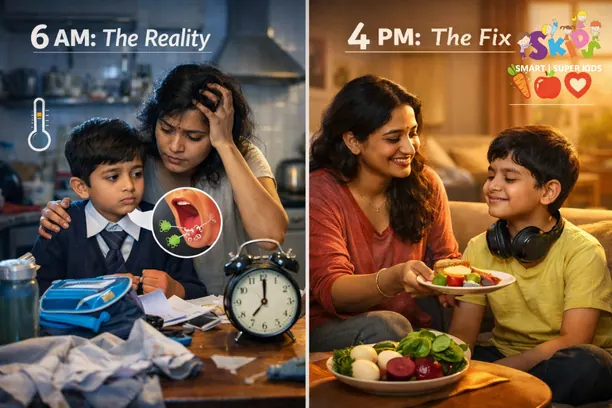
Fatima’s parents were called in for a meeting at her prestigious Doha academy. Her Year 5 teacher was concerned. ‘She’s bright, but she can’t seem to sustain attention during our digital learning modules. Her eyes glaze over.’ At home, 10-year-old Arjun, an IB student in West Bay, has meltdowns after online research sessions, is irritable, restless, and unable to settle into his homework.
Their parents, one Qatari, one Indian expat, are asking the same urgent question in 2026: Is this ADHD, or is it something else entirely?
At SKIDS Clinic GCC, we see this daily. In the demanding learning environments of 2026 Doha, where international curricula blend high academic pressure with pervasive digital delivery, a new kind of childhood fatigue has emerged. It’s not just ‘too much screen time.’ It’s a specific, neurologically taxing condition we call Digital Cognitive Load Exhaustion. And when misunderstood, it can wrongly pathologise a perfectly healthy, overwhelmed brain.
The Gulf-Specific Perfect Storm: Why Doha’s Children Are Uniquely Vulnerable
This isn’t about willpower. It’s about the biology meeting environment.
Three Gulf-specific factors are converging:
• The Indoor, Air-Conditioned Lifestyle: With most of Doha’s school year spent indoors in air-conditioned environments, children get less proprioceptive outdoor play than their nervous systems need to regulate screen-induced overstimulation.
• Curriculum Velocity: The pace of Cambridge, IB, and MOE Qatar’s STEM-integrated curricula in 2026 demands constant cognitive shifting, from a math app to a history video, to a collaborative digital whiteboard. This taxes the brain’s executive functions.
• The Blue Light / Social Jetlag Effect: Evening screen use for homework or family calls back to India disrupts circadian rhythms more severely in our region, where natural light exposure is already limited by climate and culture.
The result? A child like Yusuf or Priya presents with classic focus difficulties, but the root is not a neurodevelopmental disorder. It’s a neurological overwhelm from an environment their brains did not evolve for.
The Barker Hypothesis in the Digital Age: Early Stress, Lasting Imprint
The foundational Barker Hypothesis teaches us that early environmental stressors shape long-term health trajectories. For the Gulf child of 2026, the primary environmental stressor is no longer just nutrition; it’s the unceasing cognitive demand and sensory bombardment of the digital ecosystem.
Chronic screen fatigue in the critical developmental window (ages 5–12) doesn’t just cause tired eyes. It can wire the brain’s stress-response systems to be on high alert, lower frustration tolerance, and create a predisposition to anxiety. This is the new ‘developmental programming’ we must address. Understanding your child’s unique neurological blueprint in this context isn’t just about grades; it’s one of the most important long-term investments a family can make.
The Stakeholder Blueprint: Who Sees What?
To solve this, we must align the perspectives of everyone in your child’s life. The ‘problem’ looks different from each angle:
The School’s View (The International Teacher in Doha):
‘Layla is daydreaming during virtual lab simulations. She’s falling behind in collaborative online projects.’ Their concern is curriculum delivery and engagement metrics.
The Parents’ View (The Expat or Arab Parent):
‘Omar is so irritable after school. He fights with his sister, refuses to do his reading, but can watch videos for hours. Is he lazy?’ Your concern is his well-being and future potential.
The Child’s Reality (The 2026 Doha Student):
‘My head feels full after online class. The words on the page jump. I just want to shut my door and be quiet, but there’s always more work.’ Their experience is one of sensory and mental saturation, often expressed as avoidance or anger.
At SKIDS Clinic, our paediatricians and developmental experts act as the crucial translators between these worlds. We help the school see the biology behind the behaviour. We help parents move from worry to strategy. And most importantly, we give the child, like Ananya or Rayan, the language and tools to understand their own brain.
The SKIDS Clinic Assessment: Untangling Fatigue from Disorder
We do not jump to labels. Our first step is a comprehensive, compassionate assessment that asks:
Is this a hardware issue (a neurodevelopmental condition like ADHD) or a software issue (a system overwhelmed by digital cognitive load)?
Our process maps:
• Sensory Integration: How is the child processing the barrage of visual and auditory digital input?
• Executive Function Baseline: Measuring working memory, cognitive flexibility, and inhibitory control in both digital and non-digital tasks.
• Circadian Rhythm & Sleep Architecture: Using simple logs to connect screen exposure to sleep quality and morning alertness.
• The Environmental Audit: A deep-dive into the child’s weekly schedule, screen diet (educational vs. recreational), and physical play opportunities.
Actionable Strategies for the Doha Family (The SKIDS Shield)
Diagnosis is only the beginning. We co-create a practical, sustainable ‘Digital Hygiene Plan’, your family’s SKIDS Shield against cognitive overload.
This isn’t about banning technology; it’s about building a resilient brain.
1. The Sensory Reset Protocol:
Incorporate heavy-work activities before and after major screen sessions. For Gulf families, this could be: 15 minutes of swimming (a superb proprioceptive activity), structured play in a cool evening garden, or even indoor wall-pushing exercises. This grounds the nervous system.
2. The Pomodoro 2.0 for Kids:
Structure homework with a radical twist: 20 minutes of focused digital work, followed by a 10-minute non-visual break (listening to music, tactile play, quiet time). This respects the brain’s need to reset its visual processing centres.
3. The Blue Light & Bedtime Buffer:
Enforce a mandatory ‘analogue hour’ before bed, no screens. For expat families with late-night calls to family abroad, schedule audio-only calls or use a non-illuminated device. Protect melatonin production as a non-negotiable family value.
4. The Weekend Digital Safari:
Counteract the indoor school week with deliberate, scheduled outdoor exploration on weekends, whether a trip to the beach at dawn, a desert park visit, or a walk through MIA Park. This provides the broad-spectrum sensory input the brain craves for balance.
Your Child’s Brain Is Calling for a System Update
The focus difficulties you’re seeing in Sara or Arjun are a signal, not a sentence. They are the brain’s way of saying the current operating environment is unsustainable. In the race for academic excellence in Doha’s top schools, we must not sacrifice the neurological health required to enjoy that success.
This is the core of our mission at SKIDS Clinic GCC: to ensure that every child’s developmental journey in the Gulf is seen, understood, and optimised, not just for school, but for a lifetime of resilient, joyful learning.
Ready to Move From Worry to Understanding?
If your child in Doha, Dubai, or Riyadh is struggling with screen fatigue and focus, let’s map their unique neurological blueprint.
Our GCC-based team of paediatricians and child development specialists is here to provide clarity and an actionable path forward.
Book Your SKIDS Clinic Discovery Call.
Understand the biology. Align the stakeholders. Empower your child.