
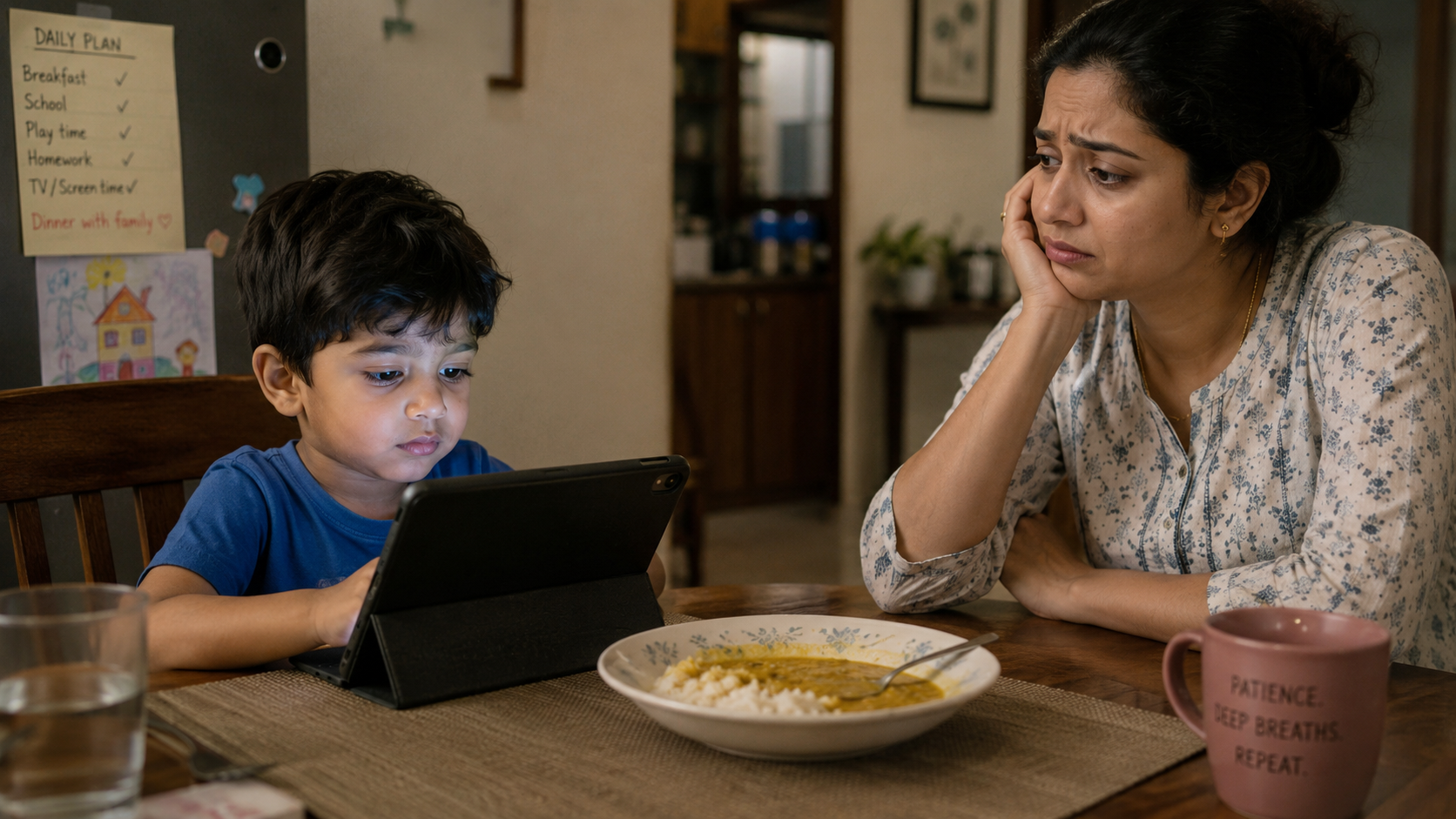
Four-year-old Vihaan sits at the dining table in Bengaluru. A bowl of dal rice remains untouched while his eyes stay fixed on an iPad playing fast-paced cartoons. His mother feels guilty but believes it's the only way he'll finish his meal. If this sounds familiar, you're not alone. Many Indian families face the same challenge. Modern parenting comes with digital devices in every home, and finding the right balance can feel overwhelming. The good news is that small, consistent changes can make a meaningful difference to your child's development.
What May Be Happening
A young child's brain is rapidly building connections that support language, attention, emotional regulation, and problem-solving. Think of the brain as a growing city where every conversation, outdoor game, puzzle, storybook, and pretend play session builds strong highways between different brain regions.
Fast-paced, passive screen content stimulates the brain with constant movement, bright colours, and rapid sound changes. While children appear engaged, they are often consuming information rather than actively interacting with it. Excessive passive screen exposure may reduce opportunities for conversation, imaginative play, movement, and social interaction—the experiences that strengthen long-term brain development.
This does not mean all technology is harmful. The quality of content, the amount of screen time, and parental involvement all matter. Watching educational content together and discussing it can be far more beneficial than leaving a child alone with a device.
Why It Matters
Healthy digital habits support:
Better attention span and concentration.
Stronger speech and language development.
Improved emotional regulation.
Better sleep quality.
Healthier eating habits without screen dependency.
More opportunities for physical activity and social interaction.
Excessive screen use, especially during meals and before bedtime, may contribute to delayed language development, behavioural difficulties, disrupted sleep, reduced physical activity, and increased dependence on digital entertainment.
What To Observe This Week
- Watch for these everyday habits:
- Does your child insist on a screen during every meal?
- Are they getting at least one hour of active outdoor play daily?
- Is screen time ending at least one hour before bedtime?
- Do they enjoy toys, books, drawing, and pretend play without asking for a device?
- Does your family have screen-free zones such as the dining table and bedroom?
- Are you watching educational content together instead of using screens as a babysitter?
- Small improvements in these routines often lead to healthier long-term habits.
When To Seek Pediatric Review
- Consult your paediatrician if your child:
- Does not make eye contact or consistently respond to their name.
- Has severe, uncontrollable tantrums whenever screens are removed.
- Experiences persistent sleep disturbances.
- Frequently complains of eye strain or headaches.
- Shows delayed speech or language development compared with peers.
- Appears unusually withdrawn from social interaction or play.
How SKIDS Thinks About This
At SKIDS, we believe technology should support childhood—not replace it. Our developmental specialists help families understand how digital habits influence communication, attention, behaviour, and learning. Through evidence-based developmental screening, we identify early concerns while guiding parents toward practical, realistic screen-time routines that fit modern family life.
We also encourage a team approach:
Parents: Delay personal devices, co-view educational content, establish screen-free bedrooms and dining spaces, and model healthy device habits.
Educators: Prioritise hands-on learning, minimise passive smartboard exposure, and discuss healthy digital routines during parent interactions.
FAQ
Is educational screen time okay for my toddler?
According to Indian Academy of Pediatrics (IAP) guidance, children younger than two years should avoid screen time except for occasional video calls. Children aged two to five years should have no more than one hour of high-quality screen time daily, ideally with a caregiver who discusses the content.
Will my child fall behind if they don't use tablets early?
No. Young children naturally learn technology quickly when they are older. During the preschool years, language, movement, social interaction, creativity, and hands-on exploration are far more important for healthy brain development.
How do I reduce tantrums when turning off screens?
Give a five-minute warning before screen time ends. Transition immediately to an enjoyable activity such as outdoor play, building blocks, drawing, reading together, or helping with simple household tasks. Consistency helps children adapt over time.
Should children eat while watching screens?
It is best to avoid screens during meals. Eating together encourages conversation, mindful eating, and healthy family bonding while reducing dependence on digital distractions.