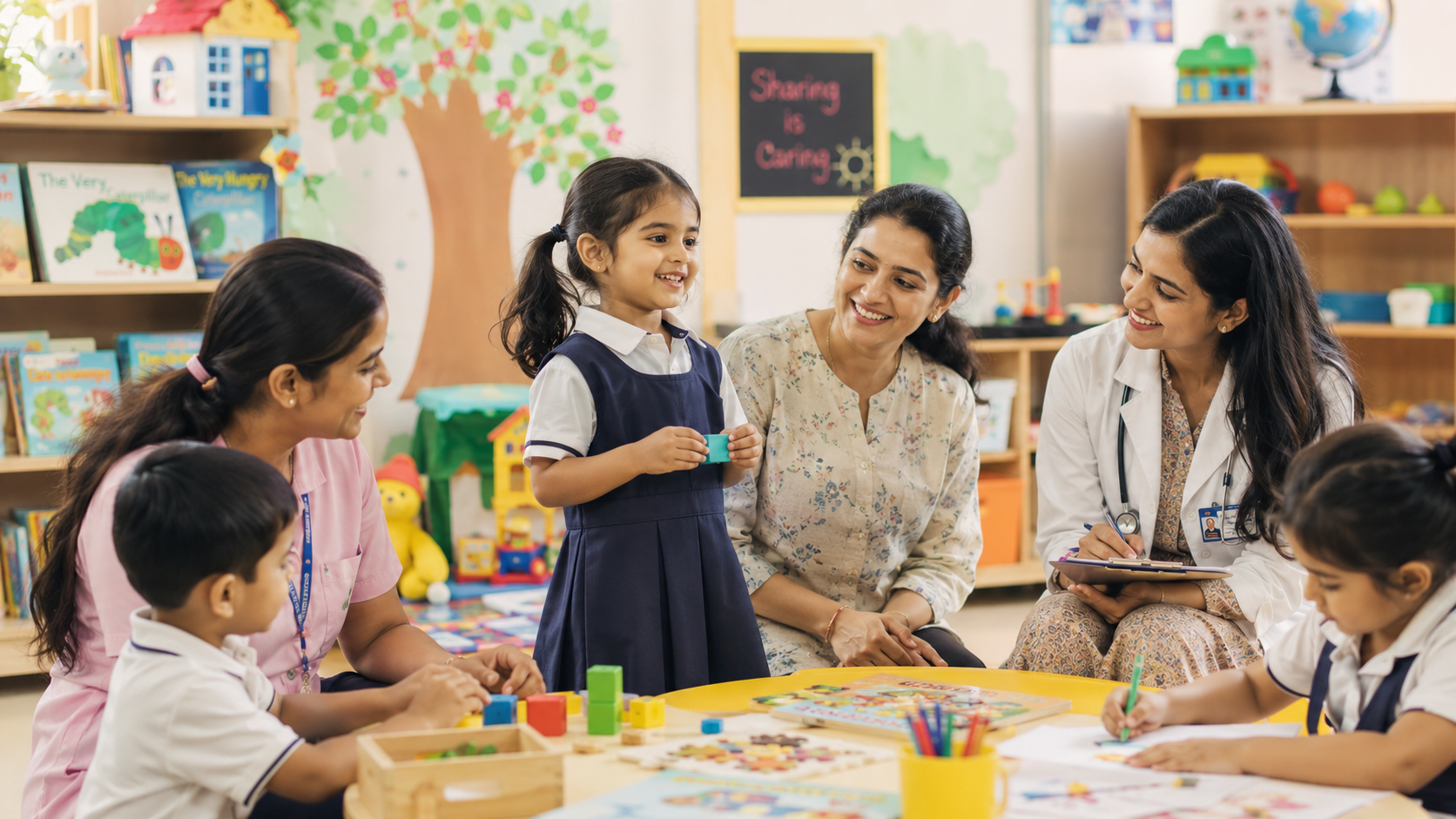
Aanya is four. She stands at the gates of her new preschool in Pune, holding tightly to her mother's hand. Her new uniform is slightly too big, and her mother wonders whether Aanya is truly ready for school. She can recognize letters and numbers, yet she finds it difficult to share toys or wait for her turn.
Many parents assume school readiness is about academics. In reality, it is much broader. A child succeeds in the classroom not simply because they know the alphabet, but because they can manage emotions, follow routines, communicate their needs, and interact with others confidently.
School readiness is the foundation for lifelong learning—not a race to early academics.
What May Be Happening
A child's brain develops through play, exploration, movement, and social interaction. Think of the brain like a busy airport. Different brain regions are the terminals, while neural pathways act as connecting flights. For smooth learning, the airport needs an efficient air traffic control system.
This "air traffic control" is called executive function. It enables children to:
Focus on tasks
Remember instructions
Control impulses
Shift attention
Solve simple problems
Regulate emotions
According to pediatric developmental research and recommendations from the American Academy of Pediatrics (AAP), play-based experiences are the primary way children strengthen these executive functioning skills. Excessive emphasis on worksheets or early academics cannot replace healthy brain development through active play.
Parents can support readiness by:
Encouraging independent self-care (toileting, washing hands, opening lunchboxes)
Reading together every day
Promoting free play and social interaction
Establishing consistent sleep and meal routines
Practicing simple daily responsibilities
Teachers can support readiness by:
Observing children during free play instead of relying solely on formal testing
Giving short, step-by-step instructions
Creating predictable classroom routines
Providing calm spaces that help children regulate emotions
Why It Matters
Children who are developmentally ready for school often:
Adapt more easily to classroom routines
Build friendships with greater confidence
Develop stronger attention and learning skills
Experience less frustration and anxiety
Become more independent learners
In contrast, difficulties with communication, emotional regulation, motor coordination, or social interaction may lead to challenges that affect confidence and academic progress if left unrecognized.
Early identification allows families to provide support before these difficulties become barriers to learning.
What To Observe This Week
- Ask yourself whether your child consistently:
- ✅ Uses the toilet independently and washes hands
- ✅ Expresses needs and feelings using words
- ✅ Separates from caregivers without prolonged distress
- ✅ Listens to a short story while remaining engaged
- ✅ Waits for their turn during games
- ✅ Holds a pencil or crayon with a finger grip instead of a fist
- ✅ Dresses with minimal assistance
- Also notice whether your child:
- Enjoys interactive play with other children
- Follows two-step instructions
- Recovers after small disappointments
- Transitions between activities without frequent meltdowns
When To Seek Pediatric Review
- Consider a developmental evaluation if your child around four years of age:
- Cannot jump in place
- Has difficulty holding a crayon steadily
- Shows little interest in playing with other children
- Cannot follow simple two-step instructions
- Experiences severe separation anxiety that persists for several weeks
- Has speech that is difficult for unfamiliar adults to understand
- Is not speaking in complete sentences by around four years
- Early developmental assessment can identify areas where additional support may help before school challenges become more significant.
How SKIDS Thinks About This
At SKIDS, school readiness is viewed as much more than academic preparation.
Our developmental screening looks at multiple domains that influence classroom success, including:
Language and communication
Gross and fine motor development
Attention and executive functioning
Social interaction
Emotional regulation
Adaptive daily living skills
The goal is not to label children, but to identify strengths and areas where timely guidance can help every child enter school with confidence.
FAQ
Does knowing the alphabet mean my child is school-ready?
Not necessarily. Academic knowledge is only one part of readiness. Emotional regulation, communication, independence, and social skills are often stronger predictors of classroom success.
My child is shy. Should I be worried?
Not always. Shyness is a personality trait rather than a developmental delay. Many shy children adapt well once they feel safe and familiar with their environment.
When should I worry about speech?
If unfamiliar adults struggle to understand your three-year-old, or if your four-year-old is not speaking in complete sentences, discuss this with your pediatrician. Early intervention is highly effective.
Can play really prepare children for school?
Yes. Play builds executive functioning, language, motor skills, creativity, and problem-solving—all essential for classroom learning.
What is the biggest misconception about school readiness?
Many parents focus only on reading and writing. True readiness also includes emotional resilience, attention, self-care, communication, and social development.