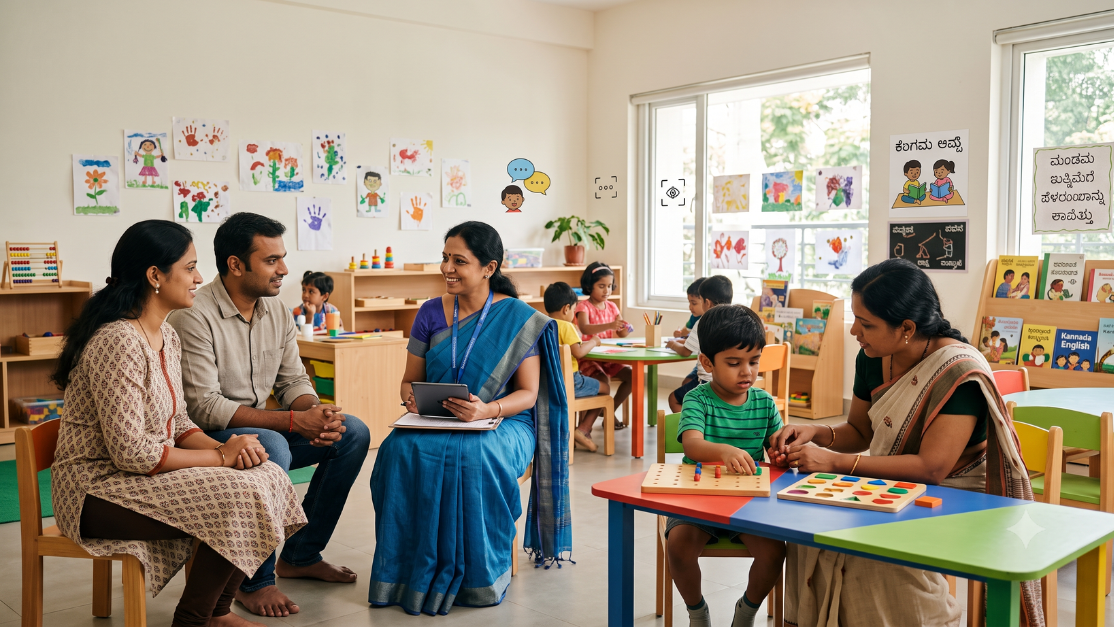
Advik, a four-year-old from Bengaluru, entered his preschool classroom excited but quickly became overwhelmed. When his teacher asked him to put away his bag and sit on the blue mat, he covered his ears and froze. His parents assumed he was simply shy. After all, he had recently passed the school's medical examination with normal height, weight, vision, and hearing.
Yet something important had been missed.
Every admission season, many children enter school physically healthy but developmentally unprepared. Traditional school health checkups focus on physical growth and general wellness, but they often overlook the developmental skills that determine whether a child can thrive inside a classroom.
True school readiness is about much more than being healthy—it includes communication, attention, emotional regulation, social interaction, sensory processing, and executive functioning.
What May Be Happening
Imagine your child's brain as a busy airport.
Executive function acts like the airport's air traffic control system. It organizes information, manages attention, filters distractions, and helps children switch smoothly between tasks.
When executive function is immature or delayed, the "air traffic control" becomes overloaded. Classroom instructions, sounds, routines, emotions, and social cues compete simultaneously, making even simple activities feel overwhelming.
A routine school medical examination tells us whether the airport is physically sound.
A developmental screening tells us whether the control tower is working efficiently.
Research supports this distinction:
The American Academy of Pediatrics (AAP) recommends standardized developmental screening at 9, 18, and 30 months to identify developmental concerns as early as possible.
The Indian Academy of Pediatrics (IAP) recommends regular growth monitoring but also emphasizes developmental surveillance throughout childhood.
The Barker Hypothesis (Barker DJ, Lancet, 1993) demonstrates that early childhood experiences and timely interventions significantly influence lifelong cognitive, behavioural, and health outcomes.
Despite this evidence, many school admission health checks in India still focus primarily on physical parameters while overlooking developmental readiness.
Why It Matters
Children who begin school with undetected developmental challenges may experience:
Difficulty following classroom instructions
Poor attention and concentration
Delayed speech and language development
Sensory overload in busy environments
Problems making friends
Emotional outbursts during routine transitions
Reduced classroom confidence
Increased academic frustration
The encouraging news is that many developmental concerns respond extremely well to early intervention. Identifying these challenges before formal schooling allows children to develop essential skills during a period when the brain is most adaptable.
What To Observe This Week
- Ask yourself whether your child can:
- Transition smoothly between daily activities without major distress.
- Follow two-step instructions such as "Pick up your shoes and place them near the door."
- Wait patiently for their turn during games.
- Play cooperatively with other children.
- Use sentences to express needs clearly.
- Dress with minimal assistance.
- Open their own lunchbox and water bottle.
- Hold crayons or pencils with an age-appropriate grip.
- Use the toilet and wash hands independently.
- Manage moderate classroom noise without becoming overwhelmed.
- These everyday observations often provide valuable clues about school readiness.
When To Seek Pediatric Review
- Arrange a developmental assessment if your child:
- Is not speaking in sentences of three or more words by age three.
- Shows extreme distress during small routine changes.
- Cannot consistently follow simple two-step instructions.
- Avoids eye contact or prefers solitary play most of the time.
- Frequently covers their ears because everyday sounds feel overwhelming.
- Experiences frequent meltdowns during transitions.
- Has difficulty interacting with teachers or peers.
- Seems significantly less independent than other children of a similar age.
- Early evaluation does not necessarily mean something is seriously wrong—it simply helps identify whether additional support could help your child succeed.
How SKIDS Thinks About This
At SKIDS, we believe school readiness extends beyond height, weight, and vision.
Our developmental screening evaluates multiple domains that influence classroom success, including:
Language and communication
Fine and gross motor development
Social interaction
Executive functioning
Emotional regulation
Attention skills
Sensory processing
Behavioural observations
Independence in daily activities
By identifying strengths and areas needing support before school begins, we help families and educators create a smoother transition into learning.
Because when developmental concerns are recognized early, children have the best opportunity to build confidence, independence, and lifelong learning skills.
FAQ
What is the difference between a routine school medical examination and a developmental screening?
A routine medical examination evaluates physical health such as height, weight, vision, hearing, and general fitness. A developmental screening assesses how a child communicates, learns, behaves, moves, pays attention, and interacts socially—all of which influence classroom success.
When should school readiness be assessed?
The ideal age is between 3 and 4 years, allowing enough time for intervention before formal schooling begins. The AAP recommends developmental screening well before school entry whenever concerns arise.
Does a developmental delay mean my child has a permanent condition?
No. Many developmental delays improve significantly with early therapy, structured home activities, and appropriate educational support. Early identification gives children the greatest opportunity to catch up.
Can excessive screen time affect school readiness?
Yes. Excessive screen exposure may reduce opportunities for face-to-face communication, imaginative play, language development, and emotional regulation. The Indian Academy of Pediatrics recommends age-appropriate limits on screen time for young children.
Can a child appear physically healthy but still struggle in school?
Absolutely. A child may have normal growth and vision yet experience difficulties with attention, language, executive functioning, sensory regulation, or social skills. Developmental screening helps identify these less visible challenges.